A large office building in central London had a problem its facilities manager couldn't quantify. Heating and ventilation were running to a full-occupancy schedule five days a week, but post-pandemic headcounts had dropped significantly — some floors were barely 30% occupied on most days. The BMS had no way to know this. It was scheduling plant based on bookings data that bore no relationship to actual attendance, conditioning air for people who weren't there. The building owner estimated the waste at over £40,000 a year in unnecessary energy spend, but without occupancy data there was no way to justify reducing schedules or prove improvement after any change.
This is the problem LightFi was built to solve. It is a UK-based smart building sensor platform that provides real-time occupancy and environmental data — not based on calendar bookings, but on whether people are actually present in a space. It is not a Building Management System replacement. It is an analytics and sensing layer that sits on top of existing BMS infrastructure, feeding it the accurate occupancy data that traditional field devices alone cannot provide.
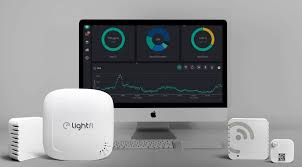
The LightFi system is built around small, wireless sensors that install in minutes without cable runs, plastering, or disruption to occupied spaces. Each node monitors occupancy (PIR or desk-level presence), temperature at point-of-use, relative humidity, CO₂ concentration, and lux levels. Sensor data is transmitted over LoRaWAN — a low-power, wide-area protocol with better wall penetration than Wi-Fi — to gateways that forward readings to the LightFi cloud platform. From there, data feeds both the facilities manager dashboard and, via API, into third-party platforms including BMS supervisors and FM software.
Room booking systems tell you what has been booked. LightFi tells you what is actually occupied. The gap between those two figures is frequently large: studies consistently show a substantial proportion of booked meeting rooms and reserved desks go unused, while other areas are at capacity for extended periods. For corporate tenants negotiating lease renewals, or landlords making decisions about floor repurposing or consolidation, continuous occupancy data at desk-cluster resolution — updated every few minutes — is significantly more reliable than headcount estimates or access control logs, which capture entry but not presence.
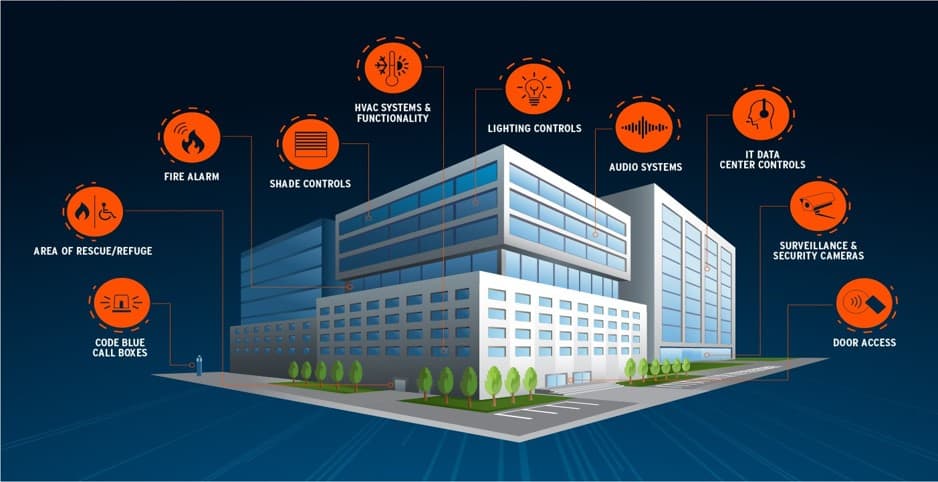
LightFi's real value in a building services context comes when its data is integrated into active BMS control strategies. Rather than scheduling ventilation on fixed time programmes, the BMS responds to real occupancy signals. Most modern supervisors — Trend IQVISION, Schneider EcoStruxure, Siemens Desigo CC — accept external data via REST API or web services. LightFi pushes occupancy and environmental readings to the supervisor, which uses them within DCV logic, setpoint modifiers, or pre-occupancy warm-up scheduling. In some configurations, LightFi data can be surfaced as virtual BACnet objects, making sensor values appear on the field network as if they were hardwired devices.
The primary control benefit is demand-controlled ventilation (DCV). When the BMS knows a floor is genuinely unoccupied, it reduces or suspends ventilation to that zone — rather than conditioning air for empty space. Approved Document Part F sets minimum fresh air rates for occupied buildings; DCV strategies that use verified occupancy data, rather than fixed schedules, can satisfy Part F compliance while eliminating the significant energy waste of conditioning unoccupied zones. For buildings targeting BREEAM In-Use credits or WELL Building Standard certification, occupancy-verified ventilation data provides documented evidence of compliance with the IAQ and ventilation prerequisites both frameworks require.
LightFi is a sensing and analytics layer, not a controls system. It does not directly control VAV dampers, fan coil unit valves, AHU fans, or any other mechanical plant — those remain the responsibility of the BMS and its field controllers. A building with LightFi but without a competently configured BMS will not automatically become more energy efficient; the two must work together. LoRaWAN connectivity requires adequate gateway coverage and periodic maintenance, and battery-powered sensors need occasional replacement — manageable considerations, but ones that should be factored into any deployment plan.
Office landlords in the commercial property sector use LightFi to provide occupancy data as a service to tenants and to evidence ESG credentials through measurable energy performance. Corporate tenants use it to understand real space utilisation as they right-size their footprint under hybrid working policies — the data is directly relevant to lease decisions and fit-out investment. Facilities managers use it to challenge fixed-schedule ventilation and heating programmes with verified occupancy data, reducing waste and building the reporting base that MEES compliance, ESOS energy audits, and SECR carbon disclosures increasingly require.
Alpha Controls are BMS specialists based in Gravesend, Kent, serving commercial buildings across London and the South East. We integrate LightFi occupancy and environmental data into your BMS control strategies — configuring API connections to your supervisor platform, programming demand-controlled ventilation logic in your field controllers, or commissioning BACnet gateway integration for direct field bus connectivity. We work across Trend, Siemens, Schneider, and Distech platforms and understand the practical realities of integrating third-party data sources into live building control systems without compromising existing functionality.
If you are considering LightFi for a new project or retrofit — or already have LightFi deployed and want to ensure the data is being used effectively within your BMS and HVAC control strategy — speak to our team. Contact Alpha Controls to discuss how LightFi integration can improve space utilisation, reduce energy consumption, and deliver the occupancy data your building needs.
Our team of building automation specialists is ready to help you optimise your building's performance and efficiency.
Get in Touch