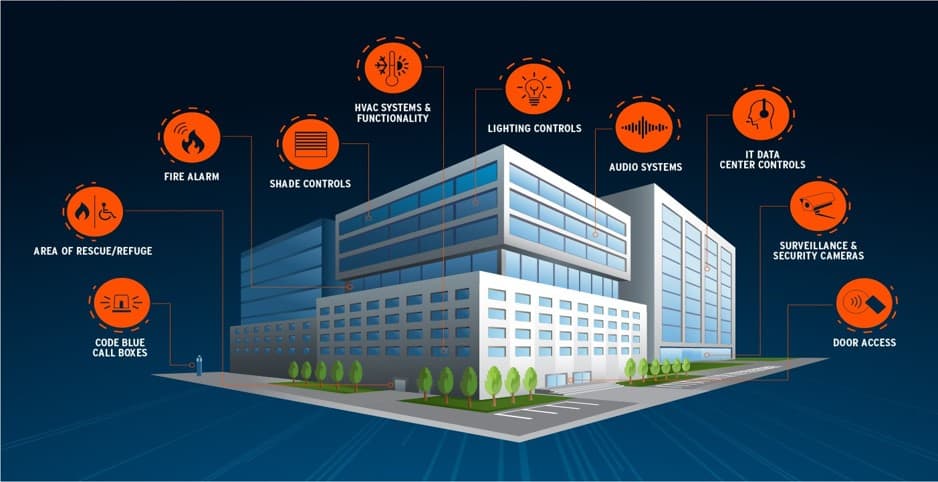
Building management system costs vary widely — from around £15,000 for a small office installation to over £500,000 for a large multi-floor commercial complex. The figures below are based on real project experience from Alpha Controls installations across London and the South East.
This guide focuses on retrofits — adding or replacing a BMS in an existing building. New build BMS costs are generally lower per point because cabling is installed before walls and ceilings are closed, but the overall figures are comparable for like-for-like scope. For a side-by-side view of new installation costs, see our guide to BMS installation cost in the UK.
| Building Type | Typical BMS Points | Indicative Cost Range |
|---|---|---|
| Small office / single-floor unit | 50–150 points | £15,000 – £40,000 |
| Medium office (2–5 floors) | 150–500 points | £40,000 – £120,000 |
| Large commercial building | 500–2,000 points | £120,000 – £350,000 |
| Multi-building estate / campus | 2,000+ points | £350,000 – £1,000,000+ |
A "point" in BMS terminology is one digital or analogue input or output — a temperature sensor, a valve position, a fan status signal. Cost-per-point is a useful rough benchmark and typically runs between £300 and £600 per point all-in for a UK retrofit, including controls, cabling, panels, programming, and commissioning.
A BMS retrofit quotation should include all of the following. Note that Approved Document Part L requires that any replacement or significantly upgraded building services system is commissioned in accordance with the relevant CIBSE Commissioning Code and that the commissioning results are documented in a building log book — this is a regulatory requirement, not an optional extra:
In a new build, cabling is installed before ceilings and walls are closed — a straightforward process. In an occupied retrofit, cables must be run through finished spaces, often requiring containment, false ceiling lifts, and out-of-hours working. This can add 30–50% to the cabling cost compared with new build.
A BMS retrofit that reuses existing actuators, sensors, and wiring costs significantly less than one that replaces everything. A survey of the existing installation before pricing is essential — many buildings have old sensors that are out of calibration or actuators that are seized, which must be replaced as part of the BMS upgrade. For a detailed guide to the specific challenges of upgrading controls in older buildings, see our article on retrofitting BMS in legacy buildings.
Controlling a simple constant-volume AHU with two-position heating and cooling valves takes hours to programme. Controlling a variable-volume system with energy recovery, free cooling, frost protection, and demand-controlled ventilation takes days. Complex control strategies can increase the programming and commissioning element significantly.
Buildings with third-party equipment — chillers, boilers, VRF systems, or fire panels — that use proprietary protocols often require gateways to bring that equipment onto the BMS network. Gateways typically cost £500–£2,000 each, plus programming time.
Some clients have an existing supervisor platform they want to retain. Extending an existing Trend IQVISION or Niagara system to incorporate new controllers is generally cheaper than a new supervisor installation — but only if the existing supervisor is capable and licenced for the additional points.
A large number of UK buildings are running Trend's 963 Supervisor, which reached end of life in January 2025. Trend no longer provides security updates for the 963. Upgrading the supervisor to Trend IQVISION — while keeping existing IQ field controllers and wiring — typically costs £8,000–£25,000 depending on site size. This is significantly cheaper than a full BMS replacement. For a full guide to your migration options, see our article on Trend 963 end of life and upgrading to IQVISION.
See our commissioning and upgrades service for more on this migration path.
The only way to get an accurate price is a site survey. A competent BMS contractor will walk the building, review existing drawings, survey the plant rooms and ceiling voids, and produce a detailed specification before pricing. Be wary of quotations produced without a site visit — they are almost always based on assumptions that won't hold.
Alpha Controls provides free site surveys for BMS retrofit projects across London, Kent, Essex, and across the South East. Request a quote to arrange a survey.
A properly designed and commissioned BMS typically delivers energy savings of 15–30% compared with a building running without automated controls. For a medium-sized office spending £100,000 per year on energy, that represents £15,000–£30,000 annual savings — meaning a BMS retrofit can pay back within 3–5 years before any maintenance cost reduction or carbon reporting benefits are counted. Under the MEES Regulations 2015 (as amended), commercial properties must achieve a minimum EPC rating of E to be legally let — tightening to C by 2027 and B by 2030; BMS upgrades that improve scheduling, setpoints, and demand response typically contribute 5–15 EPC points on SBEM assessment, making them one of the most cost-effective routes to compliance. For detail on which controls measures have the biggest impact on SBEM scoring, see our guide to MEES compliance and BMS EPC deadlines.
Energy performance recommissioning of an existing poorly-tuned BMS can often recover 10–20% energy savings at much lower cost — typically £5,000–£20,000 — with payback in under a year. The scale of savings from optimisation alone can be significant: a case study published by CIBSE Journal documented a BMS optimisation programme that saved £171,000 in nine months — without replacing any plant.
Our team of building automation specialists is ready to help you optimise your building's performance and efficiency.
Get in Touch