There's a common misconception in building services procurement that BMS work is just another line in the M&E package — something any competent electrical contractor can price and deliver alongside containment and small power. This misconception costs building owners money, creates years of performance problems, and regularly leads to disputes over systems that were signed off at practical completion but never properly worked. Building management systems are not electrical installation. They're a combination of controls engineering, software, and building physics — and a contractor without specific BMS experience will deliver a system that functions in the narrowest sense while failing in every way that matters to the building operator.
Across Kent — from Dartford and Gravesend to Maidstone, Tunbridge Wells, and the coastal towns — the demand for competent BMS contractors has grown alongside sustained investment in commercial property, education infrastructure, and healthcare facilities. Getting the right contractor on the project from the start is one of the highest-value procurement decisions a project manager can make, and one of the most consistently underestimated.
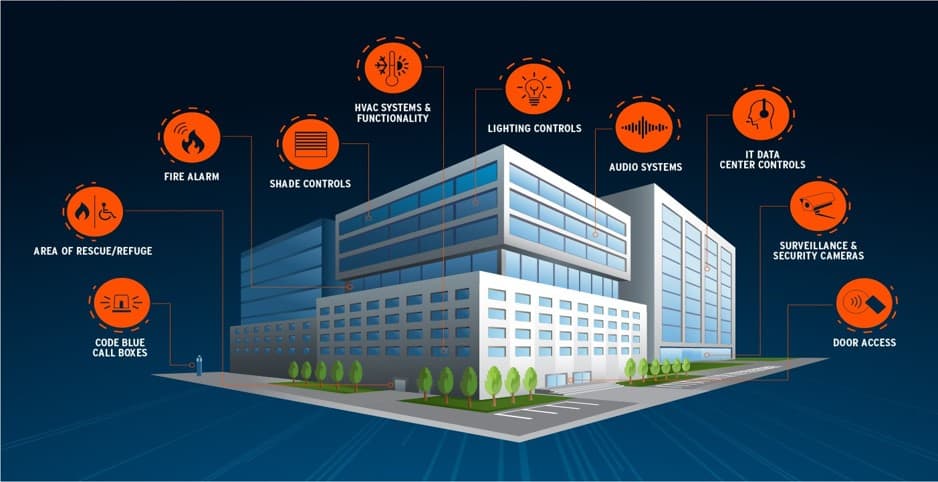
On a typical commercial project, a BMS contractor is responsible for the design and installation of the control architecture — field controllers, sensors, actuators, network cabling, and the supervisory layer — as well as writing the control software that determines how the building operates. They integrate the BMS with all connected plant: AHUs, FCUs, chillers, boilers, variable speed drives, heat meters, and sub-meters. They commission each control loop, verify sensor accuracy, tune PID parameters, configure alarm schedules, and produce the documentation and operator training that allows the building manager to use the system effectively after handover.
Approved Document L — the energy efficiency section of the Building Regulations — requires that all new commercial buildings include energy metering to allow ongoing monitoring and target-setting, and that BMS systems include features such as optimum start/stop control, weather compensation for heating circuits, and time-of-use scheduling. A BMS contractor who doesn't understand Part L will deliver a system that is non-compliant by specification, regardless of whether it clears a practical completion sign-off. These requirements apply to existing buildings undergoing material change of use or significant refurbishment as well as to new builds.
A general electrical contractor can install the hardware — run the cable, fix the controllers to the wall, connect the field wiring. What they typically cannot do is write control logic that correctly sequences an AHU with a variable speed supply fan, a modulating cooling coil, a heat recovery wheel in bypass and active modes, and a CO₂-based demand control ventilation strategy. They can't map a Modbus register table from a third-party chiller correctly into the BMS supervisor. They can't configure a BACnet network at the field controller level or troubleshoot topology issues that prevent reliable object discovery.
BS EN ISO 16484-5 — the BACnet standard — defines the protocol that allows BMS controllers from different manufacturers to communicate. Correct implementation requires understanding of BACnet object types, network addressing, binding, and supervisory integration. A contractor who has worked with BACnet on dozens of projects understands the failure modes, the edge cases, and the configuration pitfalls that appear only under specific conditions. One installing it for the first time on your project does not. The distinction matters because BACnet integration failures are often invisible at commissioning — the system appears to work, the points are mapped, the values update — but under load or after a power cycle, objects stop responding or commands from the supervisor don't reach the field controllers. By the time this is apparent, the contractor has been paid, the retention has been released, and the problem has become the building manager's to investigate. For a deeper look at open protocol choices and common pitfalls, see our article on BACnet and open protocol BMS.
The pattern is consistent across the sites we're called into. An M&E contractor wins the controls element of a project by pricing it aggressively and using an unfamiliar system. Installation proceeds, and because nobody on the design team checks the control logic in detail, the handover documentation is accepted at face value. Six months into occupation, the building manager notices that the heating runs overnight despite time schedules saying it should be off, that the AHU supply temperature doesn't respond to changes in outside air temperature, and that the BMS alarm list is generating more events per day than anyone can acknowledge.
A controls specialist is brought in and finds that the sequences were never properly written. The time schedules are configured but the plant override logic is bypassed, so a contractor's manual override from commissioning is still active. The weather compensation curve was never set for the boiler — the flow temperature runs at maximum regardless of outside conditions. The alarm thresholds were left at factory defaults, generating nuisance alarms at levels that don't reflect the plant's actual operating range. None of this would have passed a rigorous witness commissioning process.
CIBSE Commissioning Code M sets out the management requirements for commissioning — including the responsibilities of the commissioning manager, the witness and verification requirements for each system, and the documentation standards for sign-off. It places explicit responsibilities on the main contractor for ensuring commissioning is carried out to specification, not just declared complete. Where Code M obligations are written into the contract but not enforced — which happens routinely on projects where programme pressure is high — the result is systems that have been demonstrated to work once, under ideal conditions, with the commissioning engineer present, and never properly tested under real operational loads with the building occupied.
A properly delivered BMS project ends with a handover pack that includes: a full set of as-installed drawings covering panel wiring, network topology, and sensor locations; a point schedule listing every input and output with its address and engineering range; control narratives for each system explaining what the logic is intended to do and under what conditions it operates; factory acceptance test results; site acceptance test records with witness signatures; and a system user guide written for the building manager rather than the controls engineer. Operator training should cover front-end navigation, alarm acknowledgement, time schedule management, and the most common manual overrides the operator will need day to day.
When we took on the BMS maintenance at a major London law firm's office — where we also completed a full FCU controls upgrade across 16 floors using Trend controllers, working exclusively during weekend shutdowns to avoid disruption to the client — the quality of the handover documentation we produced meant that subsequent additions and changes could be carried out accurately without re-surveying the building. Good documentation is an investment that pays back every time the building needs work. Poor documentation is a cost that accumulates every time a maintenance engineer has to trace a wiring discrepancy or reverse-engineer a sequence from the running system to understand what it's supposed to do. For more on what the retrofit process looks like in an occupied building, see our guide to retrofitting legacy BMS in occupied buildings.
Manufacturer accreditation is the clearest quality signal available during procurement. Trend, Distech, Siemens, Schneider, and Johnson Controls each run formal accreditation programmes for their installation partners — accredited contractors have been assessed against the manufacturer's standards for installation, configuration, and commissioning. Beyond accreditation, ask for evidence of similar projects: building type, system scale, and the manufacturers and protocols involved. A contractor who has only worked on simple HVAC controls will struggle on a project requiring integration with fire alarm panels, access control, or tenant sub-metering.
Ask specifically what commissioning approach they use and whether seasonal performance reviews are included in the contract or treated as extras after handover. Ask about their experience with system migration if you're working on an existing building. Replacing a legacy Trend 963 network, for example, requires understanding both the old and new hardware — correct handling of point mapping between platforms, and the ability to maintain building operation throughout the transition. This is a genuinely different skill set from a clean new installation, and it requires experience of legacy systems that many newer contractors simply haven't accumulated.
For new build and significant refurbishment projects in Kent, the BMS contractor should be involved at design stage — not appointed after M&E design is complete and handed a specification to price against. Early involvement allows the controls strategy to be integrated with the mechanical design: sensor positions can be made accessible, controller locations can be practical rather than wherever space happens to be available, and the network topology can be planned rather than improvised on site. Late appointment reliably leads to control panels in inconvenient locations, sensor runs that are too long for reliable signal quality, and commissioning programmes that don't account for the sequencing constraints of the controls work.
For existing buildings where performance is below expectation, a controls audit is the most practical starting point. It establishes what's installed, what's configured correctly, and — most usefully — what's running in a way that costs money it shouldn't. In our experience, the most common finding on a controls audit is that optimum start is configured but has never been tuned correctly, and the heating plant is firing an hour or more earlier than necessary every morning. On a mid-sized commercial building, that's a quantifiable and ongoing energy cost that the BMS is supposed to eliminate. It usually takes a morning to identify and an afternoon to fix.
Alpha Controls works with developers, main contractors, M&E consultants, and building owners across London and the South East, including throughout Kent. We're accredited Trend installers with project experience across commercial office, education, healthcare, and industrial sites. Get in touch to discuss your project, or request a quote if you have a specification ready.
Our team of building automation specialists is ready to help you optimise your building's performance and efficiency.
Get in Touch