Every few months we get a call from a building manager in Kent who inherited a BMS that was installed by the wrong company. The system was specified, priced, and handed over — but three years in, it can't hold setpoints properly, the energy bills don't reflect the improvements it was supposed to deliver, and nobody on site quite understands what the controller is doing. The box is running. The failure is that the installer didn't know what they were doing beyond the physical wiring.
Finding the right BMS installer in Kent is not the same as finding the cheapest tender response or the M&E contractor who offers to throw controls in as a line item. Building management systems sit at the intersection of electrical installation, mechanical systems integration, software configuration, and energy strategy — and doing that well requires people who have done it repeatedly, across different building types, with different control manufacturers.
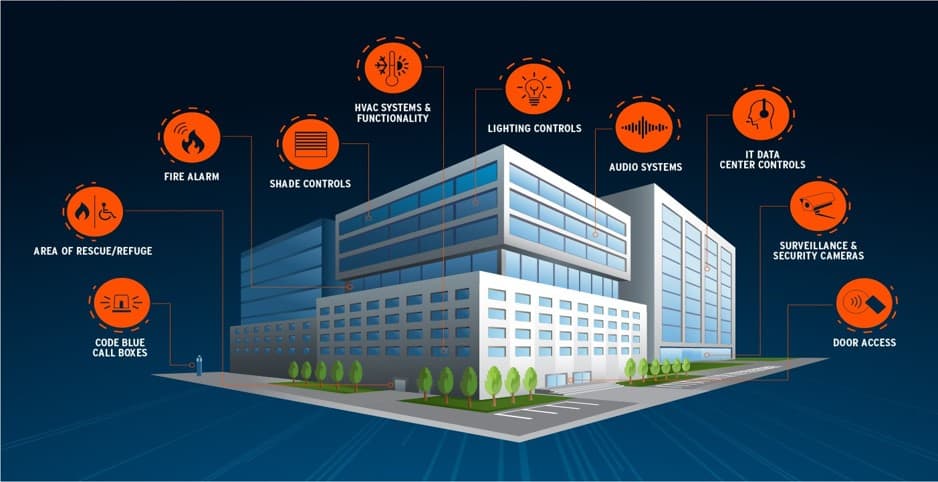
A BMS installation covers far more than running cable and mounting controllers. On a typical commercial project, the installer is responsible for designing the control architecture — deciding where field controllers sit, how they communicate, what points are hardwired versus software-configured, and how the system integrates with third-party plant such as chillers, boilers, AHUs, and FCUs from different manufacturers. They write the control logic that governs how the building responds to demand. They commission the plant — checking that sensors read accurately, that actuators respond correctly, that the control strategy actually works in the building as built rather than just on paper. And they produce documentation that the building operator can use to understand and maintain the system after handover.
CIBSE Guide H, which covers building control systems, sets out what a properly documented and commissioned BMS should look like. It specifies the minimum requirements for control strategies, point schedules, alarm hierarchies, and handover documentation. A BMS installer who delivers against CIBSE Guide H isn't just completing a task — they're leaving the building owner with something that will work for 15 to 20 years without needing to be substantially redone.
Kent has a mix of building stock that reflects its geography: converted warehouses and light industrial units along the Thames corridor; corporate offices around Dartford, Maidstone, and Sevenoaks; education buildings across multiple campuses; and healthcare facilities ranging from GP surgeries to district general hospitals. Each has different BMS requirements. A light industrial unit with a single-zone AHU needs a very different control architecture to a multi-tenanted office with four-pipe FCUs, variable speed drives on the chiller compressors, and a requirement to log energy data against individual tenants.
The point is not that every installation is complex — it's that the installer needs to understand what the building actually requires, not just how to install the hardware they're familiar with. A contractor experienced only in simple on/off controls is going to struggle with a modulating sequence for a variable air volume system. A contractor who only works with one manufacturer's controllers will try to fit every job to that manufacturer, even when an open protocol solution is a better fit for the building's long-term integration needs.
The most consistent failure mode we see when coming onto a site where the BMS hasn't performed is commissioning that was treated as a box-ticking exercise rather than a technical process. The controllers are installed, the graphics are drawn up, the customer signs a completion certificate — and two years later the building is running on default parameters because the control sequences were never properly tuned to the actual plant. Setpoint deadbands are too wide, causing heating and cooling to fight each other. Optimum start times were never calculated for the building's thermal mass, so the boiler fires three hours before occupancy. Time schedules were set up at commissioning and never adjusted, so the plant runs on bank holidays and during Christmas shutdowns.
Protocol issues are another recurring problem. BS EN ISO 16484-5, the international standard for BACnet — the most widely used open BMS communication protocol — defines how controllers and supervisors should communicate. When a BMS is installed using a proprietary protocol where an open one was specified, or when BACnet mapping has been done incorrectly, the result is controllers that appear to be integrated but are actually running independently. The supervisor shows values, but changes made at the front end don't reach the field controllers. This is surprisingly common on retrofit projects where a new supervisor layer has been placed over existing hardware without proper integration work — for more on open protocol choices and their practical implications, see our guide to BACnet and open protocol BMS.
BSRIA BG 11/2010 — the Soft Landings framework for building commissioning and handover — exists precisely to address the gap between "installed" and "working properly". It requires that commissioning is treated as an ongoing process through the first year of operation, with performance reviews and fine-tuning sessions scheduled after the building has been occupied for a full heating and cooling cycle. Very few BMS installers in any region actually work to this standard unless it is written into the contract. Those that do consistently deliver better long-term outcomes, and lower maintenance costs in years two and three.
On a 16-storey commercial office in Central London — a law firm occupying a multi-floor building in the City — we completed a phased FCU controls upgrade across 360 fan coil units over a series of weekend shutdowns, maintaining building operation throughout. Every FCU received a new Trend controller wired back to the BMS, with occupancy sensors providing real demand data to the control sequences rather than relying on fixed time schedules. The point schedule was documented, the control logic was written specifically for the building's four-pipe FCU arrangement, and a full set of as-fitted drawings and control narratives was provided at handover.
The building manager could — and does — make changes to the BMS himself using that documentation, rather than calling us for every setpoint query. That independence is exactly what good handover documentation should deliver. The energy savings from demand-led FCU control were measurable within the first heating season.
Before committing to an installer, ask which BMS manufacturers they're accredited with. Trend, Distech, Siemens, Schneider, and Johnson Controls all have formal installer accreditation programmes — an accredited installer has demonstrated competency with that manufacturer's hardware and software to a standard the manufacturer will stand behind. Ask to see examples of control narratives and point schedules from previous projects. A contractor who can't produce these either doesn't write them or doesn't retain them, and neither is a good sign for long-term system quality.
Ask how they handle commissioning — specifically whether it includes a seasonal review after the first full heating and cooling cycle. Ask about their experience with the protocol your system will use. And for larger projects involving multiple building services disciplines, ask about experience integrating with fire systems, access control, and metering platforms. A BMS that can't pass alarms to the building's CAFM system or read sub-meter data into the front-end display is a limited tool, however well the HVAC sequences are written. Integration capability is the difference between a BMS that optimises a building and one that simply monitors it — for more on what a BMS can integrate with, see our article on IoT and BMS integration.
If you're planning a new development or significant refurbishment in Kent, the BMS installer conversation should happen at RIBA Stage 2 — before M&E contractor selection, not after. The control strategy needs to inform the mechanical design. Late appointment leads to compromised control architectures that are harder to commission and more expensive to maintain over the life of the building. For existing buildings where the BMS is underperforming, a controls audit is a practical first step: it establishes what's installed, what's correctly configured, and what's costing money that it shouldn't be.
Alpha Controls provides BMS installation, commissioning, and maintenance services across London and the South East, including throughout Kent. We're Trend accredited and work across commercial office, education, and healthcare sites. If you're planning a project or want to understand what your current BMS is actually doing, get in touch or request a quote.
Our team of building automation specialists is ready to help you optimise your building's performance and efficiency.
Get in Touch