The commercial office market has changed fundamentally. Tenants now benchmark buildings on energy performance, air quality, and comfort — not just location and square footage. Building owners face MEES compliance deadlines that make Band C by 2027 a legal requirement for lettable commercial property. And with energy costs remaining high, an inefficient office building is increasingly difficult to let, finance, or sell.
A well-configured Building Management System (BMS) is the primary lever available to building owners and facilities managers to address all three challenges simultaneously. This guide explains how BMS controls work in commercial offices, what good looks like, and what kind of improvements are achievable.
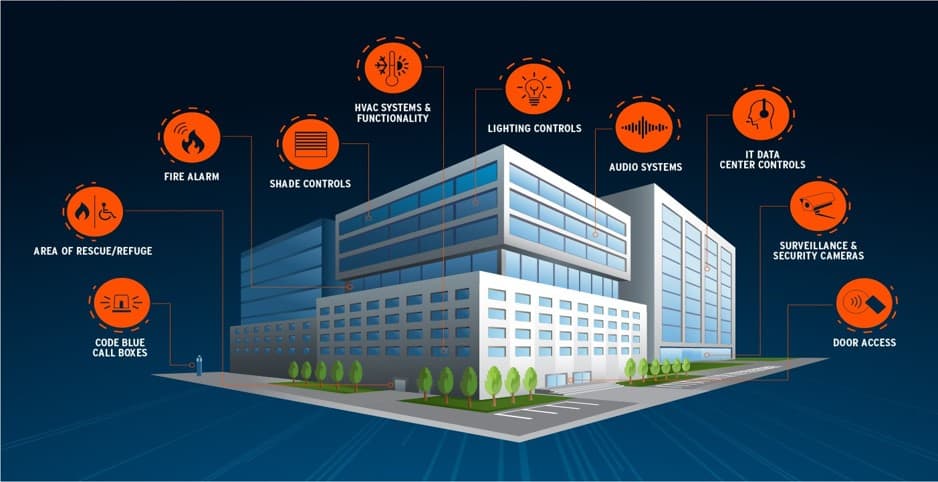
In a commercial office, the BMS coordinates all building services — HVAC, lighting controls, metering, access, and sometimes lifts — from a central supervisory platform. At the plant level it sequences chillers, boilers, cooling towers, and air handling units (AHUs). At zone level it controls fan coil units (FCUs), variable air volume (VAV) boxes, and perimeter heating to deliver comfort in individual areas of the building.
The BMS receives inputs from hundreds of sensors — temperature, humidity, CO₂, occupancy, outside air conditions — and uses them to drive actuators, variable speed drives, and control valves. The result is a building that responds dynamically to weather, occupancy patterns, and tenant demand rather than running on fixed time schedules regardless of actual conditions.
The most common tenant complaint in commercial offices is uneven temperature — one side of the floor is too hot, the other too cold. This is almost always a controls problem rather than a plant capacity problem. Root causes include:
Alpha Controls carries out BMS audits that identify exactly which zones are underperforming and why. In most cases, comfort complaints can be resolved through controls reconfiguration rather than expensive plant upgrades.
Modern BMS software includes optimisation algorithms that go beyond simple time scheduling. The most impactful for commercial offices are:
Rather than switching HVAC on at a fixed time, optimum start calculates the latest possible start time to reach target conditions by occupancy. The algorithm learns the thermal characteristics of the building over time — how quickly it heats or cools under different outside air conditions — and adjusts start times accordingly. In winter, a well-insulated office might need only 30 minutes of pre-heat; in spring, perhaps none at all. Fixed schedules typically run plant 60–90 minutes longer than needed.
CO₂-based demand-controlled ventilation (DCV) matches fresh air delivery to actual occupancy. Conference rooms that are empty for 80% of the day do not need continuous ventilation at maximum design rate. FCU speed and AHU supply volume are modulated down when CO₂ sensors indicate low occupancy and increased as rooms fill. In a typical London office building with variable occupancy patterns, DCV reduces ventilation energy by 20–35%.
On cool days when outside air temperature is below the building's cooling requirement, the BMS can use 100% outside air for cooling rather than running refrigeration plant. The enthalpy controls in the AHU compare outside air conditions with return air conditions and select the most efficient mode. Free cooling is particularly valuable in UK climates where outside air temperatures suitable for economiser mode occur for significant portions of the year.
Multi-plant buildings — larger offices with two or more chillers or boilers — benefit from sequencing strategies that run the minimum number of plant items at optimal load points. A chiller running at 70–80% load is more efficient than two chillers each at 35–40% load. The BMS sequences plant items based on load, prioritises the most efficient units, and rotates lead/lag designation to equalise running hours.
Outside occupied hours, the BMS relaxes setpoints — typically to 16°C heating setback in winter and 28°C cooling setback in summer — rather than shutting plant entirely. This prevents the building drifting to extremes that require excessive energy to recover the following morning. Frost protection is maintained automatically. On holiday periods, the BMS can extend setback beyond normal weekend schedules based on calendar inputs.
The Minimum Energy Efficiency Standards (MEES) regulations prohibit landlords from granting new leases on commercial properties below EPC Band E (in force since 2018) and will extend this to Band C by 2027 and Band B by 2030. Many existing office buildings — particularly those built between the 1970s and 1990s with legacy controls — currently rate at D or below.
BMS upgrades are a recognised measure for improving EPC ratings because they directly improve the HVAC system's Specific Fan Power (SFP), heating and cooling system efficiency, and controls sophistication score within the SBEM calculation methodology. A building that upgrades from fixed-speed AHUs with basic time-clock control to variable-speed drives with demand-controlled ventilation and optimum start can realistically see EPC improvements of one to two bands. For a detailed breakdown of which BMS measures have the biggest impact on SBEM scoring and how to plan for the 2027 deadline, see our guide to MEES compliance and BMS EPC deadlines.
Alpha Controls works with building owners and their energy assessors to understand which BMS improvement measures will have the greatest impact on EPC rating, then designs and installs a controls upgrade programme aligned to compliance deadlines. Our London and Kent teams carry out assessments with fast turnaround times for owners approaching their compliance dates.
For Grade A commercial offices, the BMS is now part of the building's ESG story. Institutional tenants — professional services firms, financial institutions, corporate occupiers — require landlords to provide energy consumption data for their own Scope 3 carbon reporting obligations under SECR and TCFD frameworks. A modern BMS with sub-metering by floor and by tenant makes this data available through automated reporting dashboards.
The WELL Building Standard — v2 edition — is increasingly specified in commercial office fit-outs targeting higher rental values; its Air concept requires CO₂ monitoring below 1,100 ppm and PM2.5 below 15 µg/m³ in occupied areas, both delivered through BMS-integrated sensors and demand-controlled ventilation. BREEAM In-Use ratings and NABERS UK assessments all require performance data that the BMS generates. Buildings with documented performance data consistently achieve higher rents and lower vacancy rates than those without.
Air quality data — CO₂, particulate matter, VOC levels — from BMS-integrated sensors can be displayed in building lobbies or fed to tenant apps, providing visible evidence of the indoor environment quality that tenants are increasingly demanding post-pandemic. For buildings using smart sensor platforms to layer occupancy intelligence on top of BMS data, see our article on what LightFi is and how it integrates with a BMS.
Most commercial office buildings in London and the South East were built or last refurbished before 2010, when BMS technology was considerably less sophisticated. Common legacy systems include Trend 963 supervisors (now end-of-life), Honeywell Excel systems, Satchwell controllers, and pneumatic controls in older stock.
Upgrading these systems in occupied buildings requires careful planning to avoid disrupting tenants. Alpha Controls specialises in phased migrations that:
Trend 963 migrations to Trend IQVISION are a particular area of expertise, as this affects a large proportion of the London commercial office stock. Where controllers cannot be reused, we carry out full infrastructure replacements using BACnet-native hardware that provides manufacturer independence going forward. Any BMS connected to a corporate network or accessible via the internet also needs to be assessed for cybersecurity risk — for a practical guide to the threats and how to mitigate them, see our article on BMS cybersecurity.
Across completed commercial office projects, Alpha Controls has delivered:
CIBSE Guide H — Building Control Systems — provides the UK specification reference for commercial BMS design, covering controller selection, communication network architecture, supervisor specification, and the functional requirements for HVAC and energy monitoring that landlords and tenants can contractually reference in building leases and service level agreements.
Whether you are managing a single office floor or a multi-tenanted commercial tower, Alpha Controls can carry out a BMS audit to identify where your building is losing energy, comfort, and compliance ground. We work across London, Kent, Surrey, Essex, and Hertfordshire.
Contact us to arrange a site visit, or request a quote for a BMS upgrade or controls audit for your commercial office building.
Our team of building automation specialists is ready to help you optimise your building's performance and efficiency.
Get in Touch