The maintenance budget request comes every few years: replace the FCUs on floors three to six because the units are old and there have been complaints. But old relative to what? And complaints about what exactly — temperature, noise, leaks? In most cases when we arrive to survey these units, the majority of the mechanical plant is in perfectly serviceable condition. What's actually failing is the controls — a worn actuator that can't close the valve fully, an analogue thermostat from 2004 that nobody can calibrate correctly, a motor running rough because nobody's changed the bearings. Full replacement of a mechanically sound unit to fix a controls problem is one of the most common and most avoidable pieces of wasted capital expenditure in commercial building maintenance.
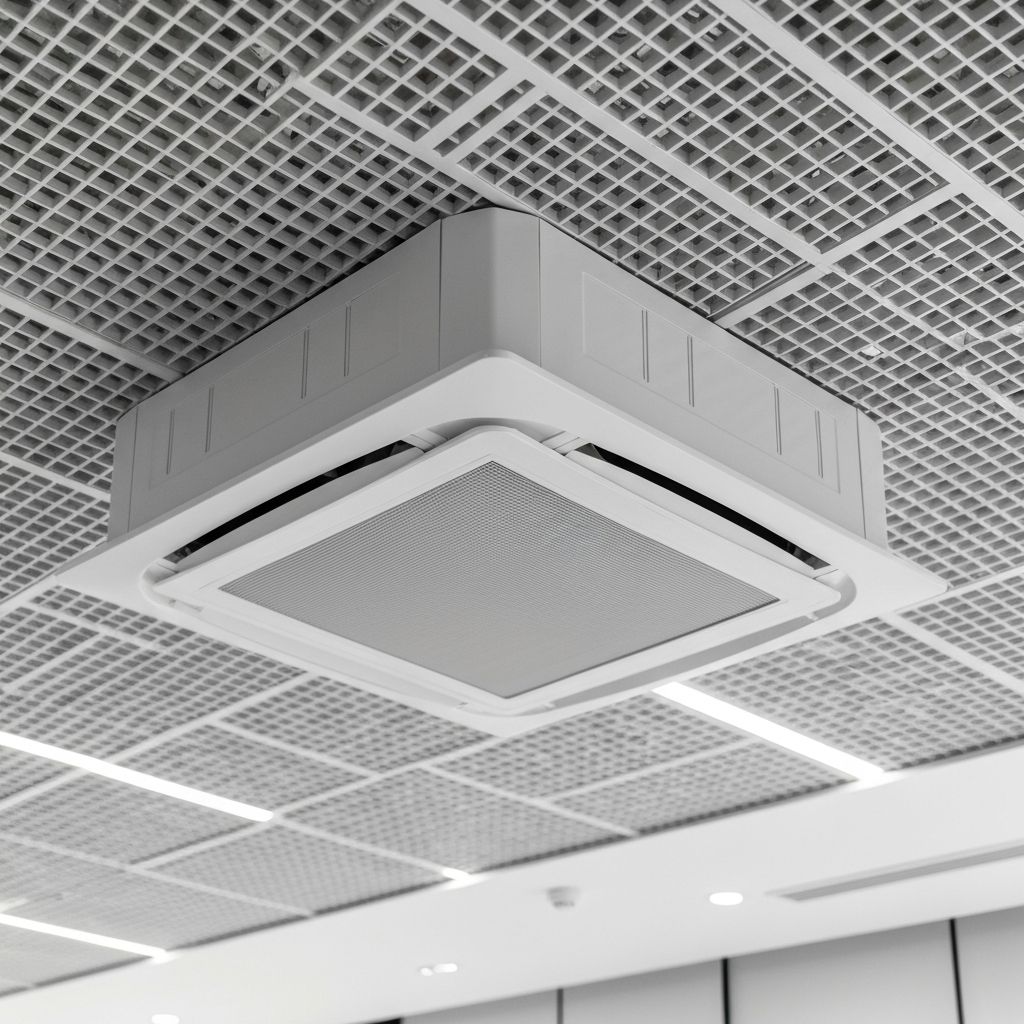
The short answer is 15 to 25 years — but that figure comes with an important caveat. A ceiling-mounted fan coil unit (FCU) is not a single component; it is an assembly of mechanical, electrical, and control elements that age at very different rates. In practice, most buildings face component-level failures well before the casing itself needs to be scrapped. Understanding which parts fail first, and when, is the key to making smart decisions about retrofit versus full replacement.
At Alpha Controls, based in Gravesend, Kent, we survey and commission FCU systems across commercial and public-sector buildings throughout the South East. The pattern we see repeatedly is that buildings with reactive-only maintenance strategies end up replacing units far sooner than necessary, while those that take a planned, data-led approach routinely get 20-plus years of reliable service from their installed plant.
To plan effectively, it helps to think about each major sub-component in isolation.
The fan motor is typically the first component to show significant deterioration. Continuous operation, bearing wear, and heat cycling all take their toll. Early warning signs include increased noise (a grinding or rattling on start-up), reduced airflow at a given speed setting, and higher-than-expected current draw. In older units fitted with AC induction motors, replacement with a modern electronically commutated (EC) motor is often the most cost-effective upgrade available — EC motors use 30–50% less energy and offer variable-speed control that integrates cleanly with a BMS.
Steel drain pans begin to corrode from the inside out, accelerated by standing condensate and any chemical imbalance in the water system. Galvanised pans are particularly susceptible once the zinc coating degrades. The first sign is usually a brown stain on the ceiling tile directly below the unit, or a BMS water-detection alarm if one has been fitted. Replacing a corroded drain pan before it perforates is far cheaper than the water damage remediation that follows a failure.
Coil longevity is closely tied to water quality. Buildings with well-maintained closed-circuit water treatment programmes regularly achieve 20 years or more without coil problems. Those with poorly controlled water chemistry — high chloride content, low inhibitor levels, or significant suspended solids — may see coil corrosion and pinhole leaks inside ten years. Four-pipe coil systems, where heating and cooling circuits are separate, tend to show corrosion on the heating coil first because those circuits are often less well-monitored. When a coil develops a leak, the decision to repair or replace the whole unit depends primarily on the age and overall condition of the casing and controls.
Valve actuators, room thermostats, and local controllers are subject to both mechanical and electronic wear. Motorised valve actuators — particularly two-port and three-port types on the heating and cooling circuits — develop stiction and positional drift over time. A common symptom visible in BMS trend data is a valve that appears to be fully open yet delivers poor heating or cooling response; the actuator is no longer moving the valve stem to its commanded position. Basic 0–10 V analogue room thermostats from the early 2000s are also increasingly difficult to source for replacement, making a controls upgrade to a modern digital room controller a practical necessity rather than an optional improvement.
Beyond the component-specific timescales above, there are clear operational signals that an FCU requires investigation:
Full FCU replacement is disruptive and expensive. In many cases, targeted retrofits deliver comparable performance improvements at a fraction of the cost. The three most common retrofit interventions are:
Replacing an ageing analogue thermostat and valve actuator with a modern BACnet room controller and smart actuator is often the single highest-value intervention available. Modern BACnet or Modbus room controllers provide proportional-integral control, occupancy scheduling, and full BMS integration — none of which a basic 0–10 V thermostat can offer. The upgrade typically takes two to four hours per unit and requires no mechanical work on the pipework or casing. For buildings with large portfolios of FCUs on a legacy controls platform, this type of controls refresh can add five to ten years of useful life to otherwise sound mechanical plant.
Adding occupancy control — via a standalone PIR sensor or integration with a room booking system — takes this further. Demand-based control that reduces fan speed and closes valves when a space is unoccupied can cut FCU energy consumption by 20–40% in intermittently occupied spaces such as meeting rooms and private offices.
Swapping a worn AC fan motor for a modern EC equivalent is a well-established retrofit that improves both reliability and efficiency. Most ceiling-mounted FCU manufacturers offer EC motor upgrade kits for their legacy product ranges, and third-party solutions are available for older or discontinued units. The key practical consideration is ensuring the new motor's speed control signal is compatible with the existing or replacement room controller — EC motors typically accept a 0–10 V or PWM input, both of which are standard on modern BMS room controllers.
Full replacement becomes the right choice when multiple major components have failed or are near end of life simultaneously, when the casing shows significant physical deterioration, or when the unit's capacity no longer matches the current thermal load of the space. Capacity mismatches are common in buildings that have undergone internal reconfiguration since the original FCU installation — a unit sized for an open-plan office may be undersized for a data room or oversized for a subdivided cellular office, leading to persistent comfort complaints that no amount of controls tuning will resolve.
For building owners and facilities managers responsible for multiple FCUs across one or more sites, a structured assessment approach produces far better outcomes than reactive fault-by-fault responses.
A physical condition survey should record the unit manufacturer, model, installation date (from the data plate or commissioning records), current condition of the casing and drain pan, actuator make and model, and room controller type. This data forms the basis of a prioritised replacement programme that smooths capital expenditure over several years rather than concentrating it when multiple units fail simultaneously.
For buildings with an existing BMS, trend data is an invaluable diagnostic tool. Key metrics to review include:
At Alpha Controls, our planned maintenance service includes BMS data trending and analysis as a standard element, allowing us to identify failing components before they cause tenant complaints or secondary damage. Our HVAC controls team can then scope and carry out targeted retrofits or recommend full replacement where the data supports it.
A practical rule of thumb: if the cost of the required remedial work exceeds 50–60% of the cost of a new unit, and the remaining components are within five years of their expected end of life, full replacement is likely more economical over a five-year horizon. If the mechanical components are sound and only the controls require attention, a controls-only retrofit almost always delivers better value.
The decision should also account for energy performance. Older FCUs fitted with AC fan motors and basic on/off thermostats are significantly less efficient than modern variable-speed EC motor units with proportional control. In buildings where energy costs are material, the payback period on a controls and motor upgrade can be as short as two to three years.
Our commissioning team can verify the performance of retrofitted or newly installed FCUs against design intent, ensuring that the controls sequence, valve authority, and airflow rates are all correctly set before handover.
CIBSE Guide M (Maintenance Engineering and Management) provides the framework for planned preventive maintenance of building services plant, including FCUs — recommending that maintenance intervals are risk-assessed and condition-based rather than purely time-based. For buildings pursuing BREEAM credits or demonstrating compliance with MEES obligations, maintaining FCU plant in good working order is directly relevant to energy performance: a building with poorly maintained FCUs — stuck valves, blocked coils, AC motors running below efficiency — will consistently underperform against its EPC modelling assumptions, making it harder to achieve or maintain the EPC rating that MEES requires for lettable commercial properties.
Approved Document L of the Building Regulations also sets a framework for the energy performance of building services in new-build and significantly refurbished buildings. FCU control systems — particularly the room setpoint tolerances and the integration with the central plant — are part of the building's energy model. When an FCU retrofit upgrades from basic analogue control to proportional BMS control with occupancy scheduling, this directly improves the building's actual energy performance against its modelled performance, which feeds into EPC calculations and building log book records maintained under CIBSE TM31.
Whether you are managing a single building in Kent or a multi-site portfolio across the South East, Alpha Controls can provide a structured FCU condition survey, BMS data review, and a costed options appraisal covering retrofit, partial refurbishment, and full replacement scenarios.
Ready to extend the life of your FCU plant? Contact Alpha Controls to arrange a site survey or to discuss your building's HVAC controls requirements with our engineering team.
Our team of building automation specialists is ready to help you optimise your building's performance and efficiency.
Get in Touch