People in the UK spend around 90% of their time indoors, and for office workers, school pupils, and hospital patients that figure is even higher. The quality of the air they breathe directly affects their health, cognitive performance, and wellbeing — yet indoor air is frequently more polluted than the air outside. Poor indoor air quality (IAQ) is associated with headaches, fatigue, respiratory irritation, and the cluster of symptoms known as Sick Building Syndrome. Studies by organisations such as the World Green Building Council have found that improving ventilation and reducing CO₂ concentrations can lift knowledge-worker productivity by as much as 11%.
Beyond occupant welfare, IAQ is increasingly a matter of regulatory compliance. Building Regulations Approved Document Part F sets minimum ventilation rates for new and refurbished buildings in England. BB101 (Building Bulletin 101) provides IAQ and ventilation guidance specifically for schools, setting CO₂ targets that directly influence how classrooms should be ventilated and controlled. In healthcare, HTM 03-01 (Heating and Ventilation Systems for Health Buildings) governs air change rates, pressure differentials, and filtration standards in clinical environments. Meeting these standards is not optional — it is a legal and contractual obligation that facilities managers and building owners must be able to demonstrate.
At Alpha Controls, our building management systems and HVAC controls are designed to make continuous IAQ compliance straightforward, automating the ventilation response and generating the audit trails that surveyors and compliance teams need.
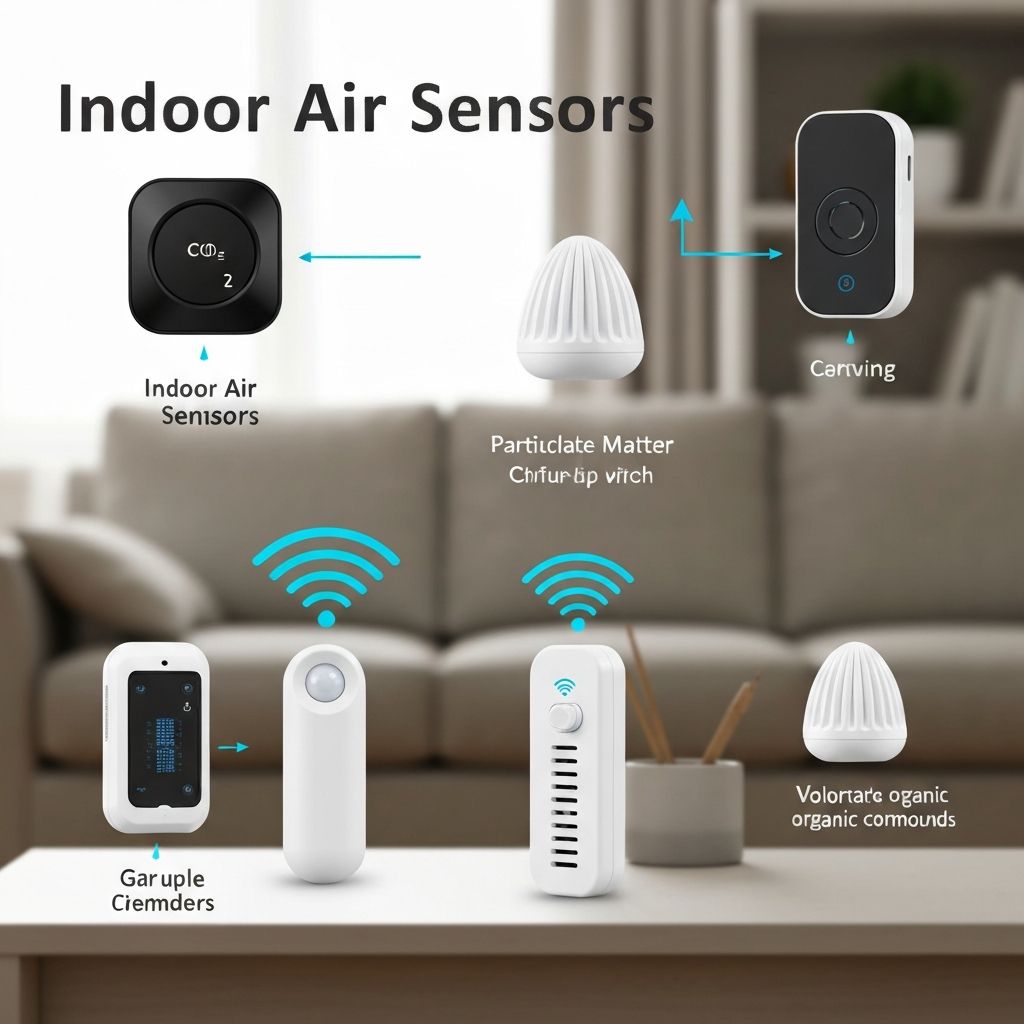
A comprehensive IAQ strategy monitors several distinct parameters, each requiring its own sensor technology and each triggering different control responses within the BMS.
| Parameter | Typical Range of Concern | Primary Source | BMS Response |
|---|---|---|---|
| CO₂ (ppm) | Above 1,000 ppm (CIBSE guideline) | Human occupancy / metabolism | Demand Controlled Ventilation (DCV) increase |
| TVOC (μg/m³) | Above 300 μg/m³ (WHO reference) | Cleaning products, furniture off-gassing, adhesives | Ventilation boost, alarm to FM |
| PM2.5 (μg/m³) | Above 25 μg/m³ (WHO annual mean) | External traffic pollution, printers, HVAC ductwork | Filter status alert, ventilation adjustment |
| PM10 (μg/m³) | Above 50 μg/m³ (UK daily limit) | Construction activity, carpet disturbance, outdoor ingress | Filter status alert, damper control |
| Temperature (°C) | Outside 20–26°C (CIBSE comfort band) | Solar gain, occupancy, plant operation | Heating / cooling setpoint adjustment |
| Relative Humidity (%RH) | Above 70% RH (mould risk threshold) | Occupancy, cooking, inadequate ventilation | Dehumidification or ventilation increase |
| Formaldehyde (ppb) | Above 100 ppb (CIBSE / WHO guidance) | New furniture, MDF, paints, carpets in new builds | High-rate purge ventilation, FM alarm |
Carbon dioxide is exhaled by building occupants and builds up in proportion to the number of people present and the adequacy of ventilation. At ambient outdoor concentrations of roughly 420 ppm, a well-ventilated space should stay below 800–1,000 ppm. CIBSE guidance classifies readings of 1,000–1,500 ppm as indicating poor ventilation, and above 1,500 ppm as unacceptable. The WELL Building Standard — increasingly specified in commercial office fit-outs — sets CO₂ limits of 1,100 ppm in regularly occupied spaces and PM2.5 limits of 15 µg/m³ averaged over 24 hours; these thresholds are more stringent than Approved Document F minimums and require continuous BMS-integrated monitoring rather than periodic manual measurement. BS EN 13779:2007 classifies indoor air quality into four categories — IDA 1 (high) through IDA 4 (low) — based on CO₂ concentration relative to outdoor air; office buildings typically target IDA 2 (medium), which corresponds to a CO₂ differential of 500–800 ppm above outdoor air levels, and achieving this consistently in a fully occupied building requires demand-controlled ventilation, not a fixed fresh air volume. CO₂ sensors therefore serve a dual purpose: they confirm that a space is adequately ventilated and they act as a reliable proxy for occupancy, enabling Demand Controlled Ventilation strategies that save energy without sacrificing air quality.
Total Volatile Organic Compounds encompass hundreds of chemical species — from the solvents in cleaning products to the off-gassing of new furniture and flooring. In newly built or recently refurbished spaces, formaldehyde (a subset of TVOCs) can reach elevated concentrations from MDF board, adhesives, and certain paints. Continuous TVOC and formaldehyde monitoring is particularly valuable during the first 12–24 months after a fit-out, when off-gassing rates are highest. BMS integration allows automatic purge ventilation to run until concentrations return to safe levels.
PM2.5 (fine particles below 2.5 microns) penetrates deep into lung tissue and is linked to cardiovascular and respiratory disease. PM10 includes coarser particles that irritate the upper airways. Both can originate from outdoor sources (vehicle exhaust, pollen) or indoor sources (laser printers, disturbed dust, kitchen activity). Optical particle counters integrated with the BMS can trigger filter-check alarms before air handling unit filters become so blocked that airflow is compromised, protecting both occupant health and plant efficiency.
CIBSE Guide A defines comfort temperature bands of 20–24°C in winter and 22–26°C in summer for sedentary office occupancies. Relative humidity should be maintained between 40% and 60% RH for comfort and to suppress airborne pathogen transmission. Above 70% RH, surface condensation and mould growth become a material risk — both a health hazard and a potential source of building damage. BMS monitoring of humidity, combined with appropriate dehumidification or ventilation control, keeps these risks in check year-round.
Modern IAQ sensors communicate with the BMS via two principal methods. BACnet MS/TP (the RS-485 serial variant of the BACnet protocol) is the most common wired integration path for commercial buildings, allowing sensors to report multiple parameters over a single twisted-pair cable run back to the field controller. Where analogue outputs are used, 0–10 V or 4–20 mA signals map a parameter's measurement range to a voltage or current band that the BMS analogue input reads and converts into engineering units.
Once IAQ data is live in the BMS, Demand Controlled Ventilation logic can be implemented. A typical DCV sequence works as follows:
This closed-loop strategy consistently outperforms fixed-schedule ventilation, typically reducing fan energy consumption by 20–40% while maintaining or improving air quality. Alpha Controls' commissioning engineers programme and validate these sequences on site, confirming sensor readings against calibrated reference instruments before handover.
Data that stays hidden in the BMS historian serves only the maintenance engineer. Increasingly, building owners and tenants want visible, accessible evidence that the spaces they occupy are healthy. Alpha Controls can configure tenant-facing displays — touchscreens in reception areas or web-based portals — showing live readings for CO₂, TVOC, PM2.5, temperature, and humidity, often rendered as simple colour-coded dials (green / amber / red).
At the FM level, automated reports can be scheduled weekly or monthly, showing parameter exceedance hours, ventilation run times, and filter life consumed. This data feeds directly into ESG reporting frameworks, evidencing the "S" (occupant health and wellbeing) and "E" (energy-efficient DCV operation) dimensions of a building's sustainability credentials. For landlords targeting BREEAM In-Use, SKA, or WELL Building Standard certification, BMS-generated IAQ logs form a core part of the evidence pack.
The COVID-19 pandemic fundamentally changed how building occupants and owners think about air quality. Return-to-office strategies frequently included published ventilation and air quality data as a reassurance measure. Certifications such as the WELL Building Standard (which has specific IAQ prerequisites including CO₂ limits, TVOC thresholds, and particulate targets) and RESET Air (a data-driven standard requiring continuous monitoring with approved sensors and third-party verified data) have grown sharply in uptake since 2020.
These standards are no longer the preserve of flagship headquarters. Mid-market office landlords, academy school trusts, and NHS estates teams are all being asked by occupants, insurers, and regulators to demonstrate that their buildings actively manage air quality — not merely meet minimum ventilation rates at design stage and hope for the best thereafter.
Correct sensor positioning is as important as sensor quality. The following rules of thumb apply to most commercial applications:
IAQ sensors drift over time. Electrochemical cells for CO₂ and TVOC can shift by 5–10% per year without correction. A robust maintenance regime should include:
Whether you are constructing a new commercial building in Kent, retrofitting a school estate to meet BB101, or preparing a healthcare facility for HTM 03-01 compliance review, Alpha Controls can design, supply, install, and commission a fully integrated IAQ monitoring solution. Our approach combines quality-assured sensors, proven BMS integration sequences, and clear tenant-facing and FM-facing reporting — giving you the visibility and the evidence you need to demonstrate a genuinely healthy building.
Ready to take IAQ seriously? Contact Alpha Controls to discuss your project, or explore our related services: HVAC controls, BMS installation, and commissioning.
Our team of building automation specialists is ready to help you optimise your building's performance and efficiency.
Get in Touch