The UK has enshrined a legally binding target to reach net zero greenhouse gas emissions by 2050. That headline figure, however, masks a more urgent picture for commercial property owners and occupiers. Many institutional landlords, listed companies, and public sector bodies have committed to internal targets of 2030 or 2035 — a decade or more ahead of the national deadline. Investors, lenders, and tenants are now using carbon performance as a direct input into asset valuation, lease negotiations, and procurement decisions.
Commercial buildings account for roughly 20% of UK carbon emissions. For the country to reach net zero, the non-domestic built environment must be almost entirely decarbonised. That means every office block, warehouse, retail unit, hotel, and healthcare facility in London and the South East needs a credible plan — and that plan has to start somewhere practical.
There is no single switch that makes a building net zero. Decarbonisation rests on three broad levers, which must be pulled in the right sequence:
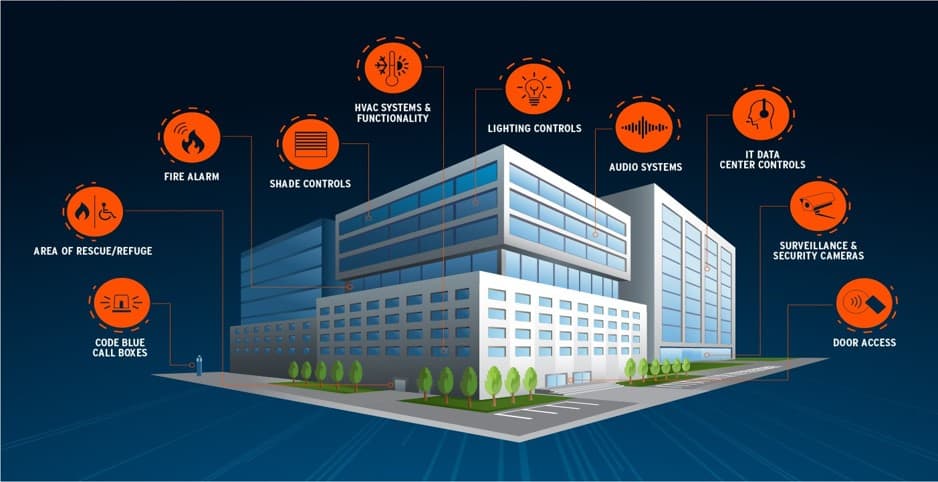
The BMS sits firmly in the third lever — but its influence reaches into all three. A well-commissioned BMS collects the data that proves whether fabric improvements have delivered their promised savings. It provides the integration layer that makes heat pumps and solar PV operate intelligently rather than in isolation. And it is the primary tool for eliminating the operational waste that makes everything else more expensive.
Most commercial buildings waste between 20% and 40% of the energy they consume through poor controls: heating running overnight, cooling fighting against open windows, plant left on through bank holidays, setpoints drifting out of calibration. None of this waste requires new capital equipment to fix — it requires a BMS audit, correct programming, and proper commissioning. Addressing operational waste typically delivers a return on investment in months rather than years, and it reduces the carbon baseline from which all future improvements are measured. If you heat a poorly controlled building with a heat pump, you have simply replaced a gas-fired waste with an electrically powered one.
Air source and ground source heat pumps are the primary pathway for decarbonising space heating in commercial buildings. But heat pumps are fundamentally different from gas boilers — they operate most efficiently at lower flow temperatures and respond poorly to on-off cycling. A BMS that is correctly configured for heat pump operation manages weather compensation curves, optimises start times using predictive algorithms, and sequences multiple units to maintain efficiency across varying loads. Without capable controls, a heat pump installation will underperform against its design specification and may actually increase operating costs compared with the gas plant it replaced.
Scope 1 emissions (direct combustion of gas and oil on-site) and Scope 2 emissions (purchased electricity) must both be quantified accurately for corporate carbon reporting. BMS sub-metering — breaking down consumption by floor, zone, end-use category, or tenant — provides the granular data that makes this possible. Without it, organisations are forced to rely on estimated half-hourly meter data allocated by floor area, which produces figures that are both inaccurate and impossible to improve upon because the source of waste cannot be identified. Approved Document Part L sets the regulated energy performance baseline that BMS optimisation is measured against — a BMS that demonstrably reduces energy consumption below the Part L notional building model contributes directly to an improved EPC rating, which in turn affects asset value, leasability under MEES, and access to green finance. For whole-life carbon assessments, CIBSE TM65 provides the methodology for calculating the embodied carbon of building services equipment — including BMS controllers, wiring, and sensors — so that the BMS's operational carbon savings over its service life can be weighed against the embodied carbon of the installation itself.
The Carbon Risk Real Estate Monitor (CRREM) has become the standard tool used by institutional landlords, real estate investment trusts, and their advisers to assess whether a building is on a net zero pathway. CRREM provides science-based carbon intensity targets — expressed in kgCO₂e per square metre per year — for each building type and country, with the target becoming more stringent every year out to 2050.
A building that is currently above its CRREM pathway is said to be "stranded" — meaning it faces the risk of becoming unlettable or unsaleable as the target tightens and occupiers with their own net zero commitments refuse to take space in high-carbon assets. BMS sub-metering data feeds directly into CRREM assessments. The better the metering, the more accurately the current carbon intensity can be established and the more precisely the gap to the pathway can be quantified. Landlords who cannot demonstrate verified consumption data are in a weaker position when presenting assets to institutional buyers or green financing providers.
Regulatory and investor-driven reporting requirements are creating a parallel pressure on building operators to produce auditable energy and carbon data:
There is a well-worn debate in sustainability circles about whether buildings should prioritise fabric improvements or low-carbon energy supply. The correct answer, in almost every commercial building case, is neither — controls optimisation should come first.
The logic is straightforward. If a building is currently wasting 30% of its energy through poor controls, then every capital investment in insulation or heat pumps is being sized against an inflated baseline demand. A heat pump system designed to replace a poorly controlled gas boiler will be over-specified and over-budget compared with one designed after the controls have been fixed and the genuine heating demand established. Similarly, solar PV generation displaces less grid electricity than it should if the building is simultaneously wasting power through unoccupied equipment and misconfigured plant.
Fixing the controls first is cheaper, faster, and makes every subsequent investment more efficient. It also provides the baseline metering data needed to specify fabric and energy supply measures correctly. The one qualification is MEES compliance — where a building faces an imminent EPC deadline, fabric and controls work may need to be sequenced in parallel. See our guide on MEES compliance and BMS for more detail on that interaction.
Based on our experience working with commercial buildings across London and the South East, a practical net zero roadmap typically follows this sequence:
Alpha Controls is a specialist BMS installer based in Gravesend, Kent, serving commercial buildings across London and the South East. We offer BMS energy audits as the first step of a net zero roadmap — an independent assessment of your current controls, what they are costing you, and what a realistic improvement programme looks like.
Whether you are a building owner trying to get ahead of CRREM stranding risk, a facilities manager under pressure to meet an internal 2030 carbon target, or a finance director facing the first year of SECR reporting, the right starting point is the same: understand what your building is actually doing, fix the waste, and build from there.
To discuss a BMS energy audit for your building, contact the Alpha Controls team. You can also learn more about our BMS services and commissioning capability.
Our team of building automation specialists is ready to help you optimise your building's performance and efficiency.
Get in Touch