The call comes in from the FM team: tenants on the third floor are complaining about stuffiness and headaches, and the building manager has already confirmed the FCUs are running. The maintenance contractor checks the plant room — chillers are running, the pumps are on, the FCUs are pushing air. On paper, everything is working. The problem is that the FCUs were never going to fix this, because stuffiness and CO₂ buildup aren't a temperature problem. They're a ventilation problem, and FCUs don't do ventilation.
This confusion between what AHUs and FCUs do — and why most commercial buildings genuinely need both — is one of the most common misunderstandings in building services. It leads to comfort complaints, energy waste, and compliance failures that no amount of FCU tweaking will resolve.
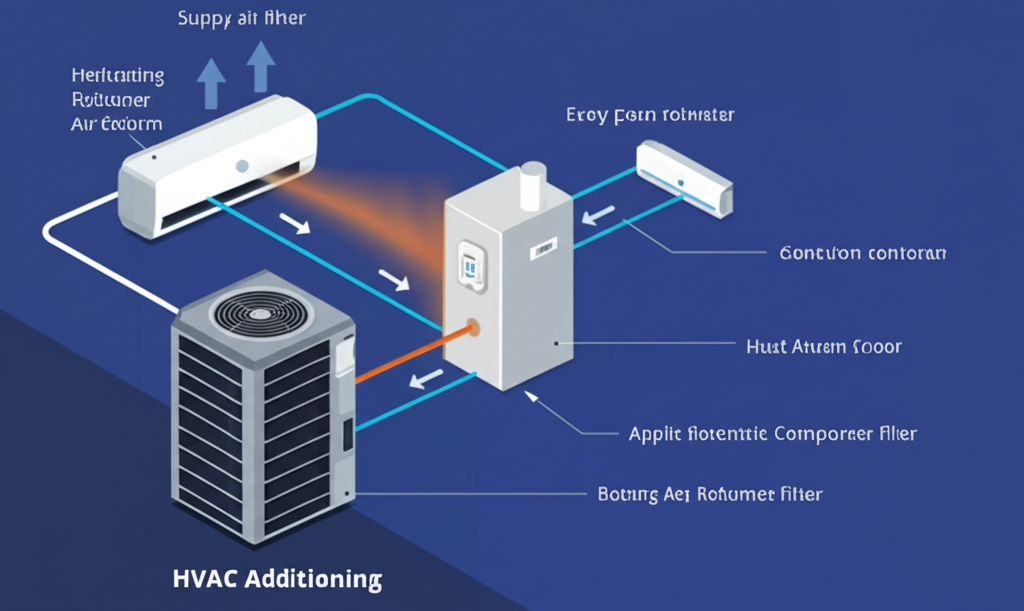
An Air Handling Unit is centralised plant — typically in a plant room, roof space, or basement — whose primary job is ventilation: bringing in outside air, filtering it, conditioning it to a suitable supply temperature, and delivering it to occupied spaces through a ductwork system. A standard commercial AHU will contain supply and extract fans, G4 and F7 filter stages, a heating coil fed from the building's LTHW circuit, a cooling coil on the chilled water circuit, and a heat recovery section — either a rotary heat wheel or a plate heat exchanger — that recovers 60 to 85% of the energy in the exhaust air before it's discharged outside. BS EN 1886:2007 classifies AHU casings by leakage class — from L1 (near-airtight) to L3 — and thermal performance class; a well-specified AHU for a commercial building should meet at minimum Class L2 and T2, ensuring the treated air delivered to the space isn't contaminated by leakage through the casing or degraded by heat transfer through poorly insulated panels.
The AHU serves entire floors or zones. It is the only source of fresh outside air in a sealed modern building. Approved Document F requires that occupied commercial spaces receive a minimum of 10 litres per second of outdoor air per person, with a minimum background rate of 0.5 l/s/m² regardless of occupancy — in a sealed building with no openable windows, the AHU is the only mechanism for meeting this requirement, and those rates must be met through mechanical ventilation. CO₂ sensors in the BMS measure occupancy-driven buildup and modulate the AHU's fresh air volume accordingly, a strategy called Demand Controlled Ventilation. When this is set up correctly, the AHU ramps up fresh air delivery as a floor fills up and dials it back overnight. When it's not — when the AHU is running at a fixed flow rate regardless of occupancy — you're either under-ventilating full floors or over-ventilating empty ones, or both at different times of day.
A Fan Coil Unit is a small distributed terminal unit, usually concealed in the ceiling void directly above the space it serves. It draws room air back in through a return grille, passes it over a heating or cooling coil, and delivers conditioned air back to the same room. It works entirely with recirculated air. No matter how many FCUs a room has, no matter how hard they run, they cannot bring in fresh air or reduce CO₂ levels. Their job is comfort conditioning — responding quickly to localised heat gains from people, computers, and solar radiation — not ventilation.
Two-pipe FCUs share a single coil that switches between heating and cooling across the whole building — meaning you're either in heating season or cooling season, with no ability to heat one side of the building while cooling the other. Four-pipe FCUs have separate heating and cooling coils on independent circuits, allowing south-facing zones with solar gain to be cooled while north-facing perimeter zones are heated simultaneously. For any commercial office building with mixed orientations and year-round occupancy, four-pipe is the only arrangement that works properly. Two-pipe systems generate consistent complaints from tenants in shoulder seasons when half the building is in the wrong mode.
A related consideration in buildings with aging FCU installations is equipment lifespan. For a detailed guide on when fan coil units need replacing and what a controlled refresh programme looks like, see our article on ceiling-mounted FCU lifespan, retrofit and replacement.
The reason commercial buildings use both systems is straightforward: the AHU provides the minimum ventilation required by Part F, but it's an inefficient way to maintain precise comfort temperatures across many individual zones. Running an AHU to deliver large volumes of conditioned air at varying temperatures to every zone in a multi-tenanted building is expensive, slow to respond, and impossible to zone finely. Instead, the AHU delivers a constant volume of fresh air at a neutral supply temperature — typically 16–18°C in summer — and the FCUs in each zone handle the comfort conditioning, responding quickly to local demand.
This split of responsibilities also makes heat recovery practical. The AHU's rotary heat wheel recovers energy from exhaust air before it leaves the building — energy that would otherwise be wasted. An FCU alone cannot do this. On a well-commissioned system, heat recovery on the AHU alone typically reduces heating energy consumption by 30 to 40% compared with a direct fresh-air system with no recovery. That's a meaningful figure on a building spending £80,000 a year on gas.
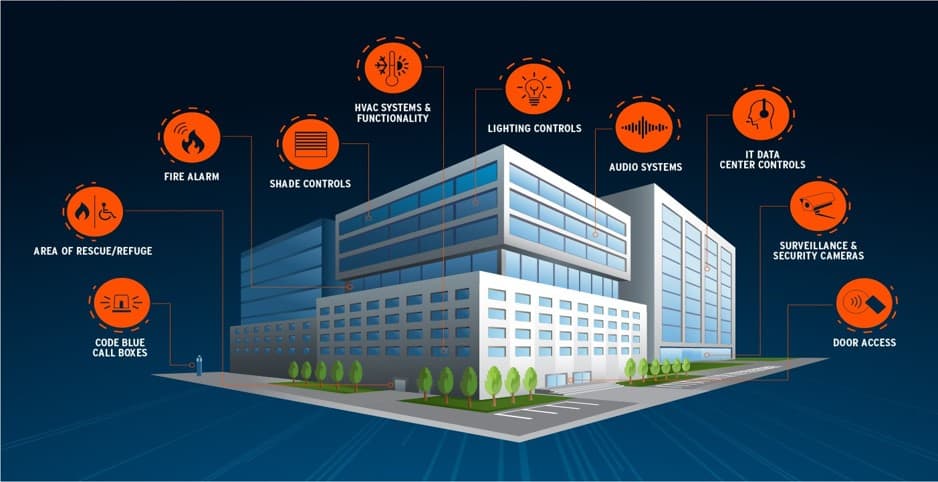
In a properly configured BMS, the AHU and FCU systems are managed together to prevent the waste that occurs when they work against each other. The most important function is supply air temperature reset — rather than maintaining a fixed AHU supply temperature year-round, the BMS adjusts it based on the aggregate demand from all FCU zones. If most zones are calling for cooling, the AHU cools its supply air further, reducing the load on individual FCU cooling coils. If most zones are in heating, the supply temperature rises. This single optimisation routinely delivers 10 to 15% energy savings on buildings where it's been properly implemented, because it reduces the work both the AHU and the FCUs are doing simultaneously.
CO₂-based demand control on the AHU and fan speed modulation on the FCUs — where fans drop to minimum speed when temperature demand is low — are the next highest-impact measures. Both are software changes to the BMS and require no physical plant modifications. On sites we've recommissioned, the combination of supply temperature reset, DCV, and FCU fan speed control has delivered 15 to 25% energy savings without touching a valve or replacing a coil.
The most frequent problems we encounter in buildings with combined AHU and FCU systems fall into a consistent pattern. AHUs are often left at fixed design supply temperatures year-round — set at commissioning and never revisited — meaning the chiller runs continuously through mild shoulder seasons when it isn't needed. FCU fans are frequently left running at full speed continuously, with no modulation, generating noise complaints and unnecessary energy consumption. Heat recovery wheels are sometimes bypassed during commissioning to speed up functional testing and never re-enabled — a fault that's invisible on the front-end display but costs real money in recovered energy every day.
Four-pipe FCU systems are occasionally configured with incorrect changeover logic that prevents the heating coil from operating during the cooling season, leaving perimeter zones cold on north-facing elevations throughout summer. And Demand Controlled Ventilation — which is almost universally specified on new builds — is frequently not functioning correctly on systems more than a few years old, either because CO₂ sensors haven't been calibrated or because the control logic was never properly commissioned in the first place.
If your building has FCUs but comfort complaints persist — particularly CO₂ or stuffiness complaints from fully air-conditioned floors — the AHU is the first place to look, not the FCUs. CO₂ and stuffiness are ventilation problems, not temperature problems — for a detailed look at why modern sealed buildings depend entirely on their AHUs for fresh air, see our guide to why sealed buildings need AHUs for fresh air ventilation. If you're seeing high energy bills from HVAC but can't identify where the consumption is coming from, supply temperature reset and DCV are usually the quickest wins. For more on how CO₂ monitoring underpins good ventilation control, see our article on indoor air quality monitoring. And if you're planning a BMS upgrade or retrofit, the relationship between AHU and FCU control strategy deserves as much attention as the hardware specification.
Alpha Controls installs and maintains HVAC controls across London and the South East, including AHU and FCU systems on commercial offices, education buildings, and healthcare sites. If you have concerns about how your building's systems are performing, get in touch or explore our recommissioning service.
Our team of building automation specialists is ready to help you optimise your building's performance and efficiency.
Get in Touch