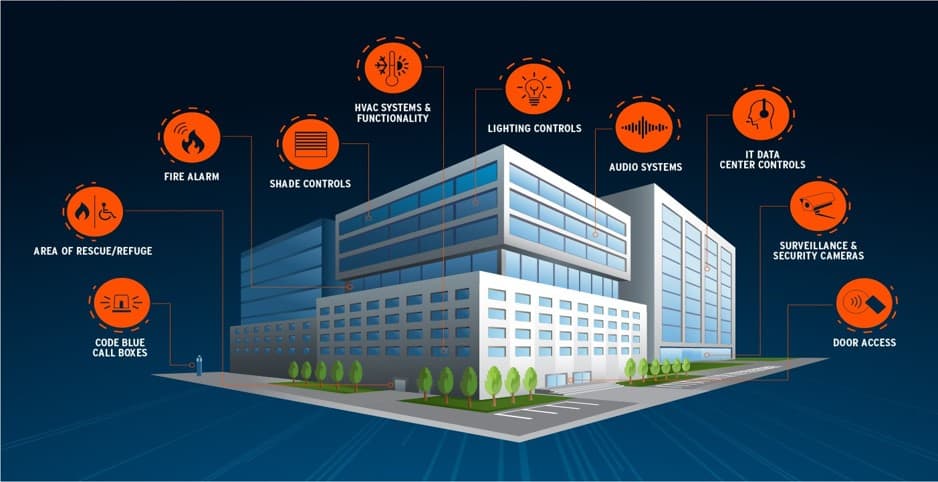
Picking a BMS platform isn't like choosing a boiler brand. A boiler does one thing. A BMS platform is the nervous system of your building — it determines what you can control, how you monitor it, what integrates with what, and critically, what happens in five years when the building's needs change and you need to extend or adapt. Get this decision wrong at specification stage and you're living with the consequences for a decade or more.
For UK commercial buildings, two platforms dominate the conversation: Trend Controls and Distech Controls. Both are serious, both are proven, and both have vocal advocates. But they're not the same product, they don't serve the same market in the same way, and the right choice depends entirely on what you're trying to achieve, who's going to maintain it, and what the building looks like in practice — not just on the drawings.
We install and maintain both platforms daily. This isn't a manufacturer's brochure. It's a practical comparison from a contractor's perspective, covering the things that actually matter once the hardware is on the wall and the building is occupied.
Trend's current mainstream controller is the IQ4 series — a direct digital controller that's been the backbone of UK commercial BMS for years. The IQ4 runs Trend's proprietary operating environment, supports BACnet/IP and BACnet MS/TP communication (per BS EN ISO 16484-5, the international BACnet protocol standard), and integrates with Trend's 963 Supervisor and IQ Vision platforms for front-end graphics and alarm management. It's a known quantity. UK engineers have been installing and commissioning IQ4s for years, the training infrastructure is well-established, and the supply chain is mature.
Distech's flagship is the ECLYPSE series — a connected controller platform built on the Niagara Framework (Tridium). ECLYPSE controllers run an embedded Niagara runtime, which means they can function as both a controller and a server in one box. They support BACnet/IP natively, as well as RESTful APIs for modern IT integration. The ECLYPSE Connected System Controller (ECY series) can host its own web-based graphics without needing a separate supervisor, which fundamentally changes the system architecture for smaller sites.
The architectural difference matters. A Trend system typically follows a traditional three-tier model: field controllers (IQ4), a network layer, and a central supervisor (963 or IQ Vision) that provides the graphical interface and alarm management. A Distech ECLYPSE system can collapse the supervisor tier into the controller tier for smaller installations, or scale up to a full Niagara-based supervisor (EcoStruxure Building Operation or a third-party Niagara platform) for larger estates. That flexibility is one of ECLYPSE's strongest selling points — but it also introduces complexity that needs to be managed.
Integration capability is where the real differences emerge, and where the specification decision has the most long-term impact.
Trend IQ4 controllers speak BACnet fluently. They integrate well with other BACnet devices, and Trend's supervisor platforms can pull in third-party data points from any BACnet-compliant system. For UK buildings running a predominantly Trend estate, adding a new plant item with a BACnet interface — a chiller, a VRF system, a metering gateway — is straightforward. Where Trend gets more constrained is in non-BACnet integration. Connecting to Modbus devices requires gateway modules. Integration with modern IT systems, cloud platforms, or IoT devices typically requires additional middleware or a dedicated integration layer. Trend's ecosystem is robust but relatively closed compared to what Niagara-based platforms can offer.
Distech ECLYPSE, being Niagara-based, is inherently a multi-protocol platform. Niagara was designed from the ground up as an integration framework — it speaks BACnet, Modbus (per BS EN 61158, the fieldbus standard covering Modbus and other protocols), LON, KNX, and can connect to virtually any IP-based system via its driver architecture. For buildings with mixed plant from multiple manufacturers, or where the brief requires integration with lighting control, access control, metering systems, or cloud analytics platforms, ECLYPSE's Niagara backbone provides a native pathway that doesn't require bolting on additional integration hardware.
This is particularly relevant for retrofit projects. If you're upgrading a building that has legacy plant from three different manufacturers, a platform that can talk to all of them natively is a significant advantage. We've seen projects where specifying Distech saved meaningful cost on gateway hardware and reduced commissioning time because the integration work happened at the software level rather than through physical protocol converters.
However — and this is important — that integration flexibility comes with a knowledge requirement. Niagara engineering is a distinct skill set. Not every BMS engineer can programme a Niagara station competently, and the quality of the engineering matters significantly. A badly configured Niagara system is considerably harder to untangle than a badly configured Trend system, because the platform's flexibility means there are more ways to get it wrong.
This is where specification decisions made in a consultant's office translate into real operational cost for the building owner, and it's an area where the two platforms differ substantially.
Trend's licensing model is relatively straightforward. You buy the hardware (controllers, supervisor), you pay for commissioning, and the ongoing software cost is modest. Trend 963 Supervisor licences are perpetual — you buy them once and they don't expire. Software updates are available but not mandatory, and the system continues to function without an active software subscription. For building owners who want predictable costs and don't want to be locked into annual software fees, this is a meaningful advantage.
Distech ECLYPSE, via the Niagara Framework, carries a different cost structure. Niagara licences are tied to the Niagara runtime — each controller running Niagara requires a licence, and supervisor-level Niagara installations require their own licensing. Tridium (Honeywell) manages the Niagara licensing programme, and while the specific commercial terms vary by region and reseller, the ongoing cost of Niagara licensing is a factor that needs to be accounted for in the total cost of ownership. Software Maintenance Agreements (SMAs) are typically expected to keep the platform current and maintain access to updates and technical support.
For a small site — say, a single office building with 20-30 controllers — the licensing cost difference may not be decisive. For a large estate or a portfolio of buildings, the cumulative Niagara licensing cost can be significant, and it needs to be factored into the lifecycle cost comparison from day one. We've seen projects where the hardware cost was comparable but the ten-year software licensing cost tipped the balance in Trend's favour by a meaningful margin.
Consultants specifying BMS platforms should be presenting both the capital cost and the projected lifecycle cost to their clients. If the comparison only shows Day 1 hardware pricing, it's incomplete. CIBSE Guide H: Building Control Systems explicitly states that lifecycle cost — including software licensing, maintenance, and eventual replacement — should be considered as part of the specification process for building control systems. Any honest platform comparison needs to follow that principle.
A BMS platform is only as good as the support network behind it. Both Trend and Distech have strong manufacturer support, but the practical support ecosystem in the UK is different.
Trend has been the dominant BMS platform in UK commercial buildings for decades. The result is a deep pool of Trend-accredited engineers, a well-established training programme, and a network of approved installers and maintenance providers across the country. If your Trend system needs emergency support, there are multiple contractors in most regions who can attend, diagnose, and fix the problem competently. That depth of resource is Trend's most underappreciated advantage — it's not glamorous, but it's what determines whether your building gets fixed on Saturday morning or waits until Monday.
Distech's UK support ecosystem is growing but hasn't yet reached the same depth. Distech (part of Acuity Brands) has invested heavily in UK market development, and the number of trained ECLYPSE engineers is increasing. However, finding a Niagara-competent engineer who also knows the Distech hardware platform intimately is still harder than finding a Trend IQ4 engineer in most parts of the UK. For buildings outside London and the South East, this can be a practical constraint on reactive maintenance response times.
This isn't a permanent limitation — the market is shifting, and Distech's UK presence is expanding. But for a building being specified today that needs to be maintained for the next 15 years, the current and projected depth of the support ecosystem is a factor that should influence the decision. If you're choosing Distech, make sure you've identified at least two competent maintenance providers in your area before the ink dries on the specification.
From our perspective as a contractor who works with both platforms, the most common specification mistakes fall into predictable patterns.
The first is specifying a platform based on the consultant's familiarity rather than the building's needs. Some consultants default to Trend because it's what they've always specified. Others push Distech because they've been impressed by a manufacturer presentation. Neither approach serves the building owner well. The right platform is the one that best matches the building's integration requirements, the client's operational capability, the available maintenance resource in the area, and the lifecycle cost profile that works for the ownership structure.
The second mistake is under-specifying the supervisor. Both platforms can deliver excellent front-end graphics and alarm management, but only if the supervisor is properly specified and the engineering budget includes adequate time for graphics development, alarm strategy configuration, and user training. A BMS with a supervisor that nobody uses because the graphics are confusing and the alarms are overwhelming is a BMS that isn't delivering its value — regardless of which platform it's running on. We see this across both Trend and Distech sites, and it's always a specification and commissioning failure, not a platform limitation.
The third is failing to consider the handover and documentation requirements. BSRIA BG 11/2010 (Soft Landings) requires that system documentation be complete, accurate, and transferable at handover. For Trend systems, this means controller databases, supervisor configurations, points schedules, and sequences of operation. For Distech ECLYPSE systems, the Niagara station backups, driver configurations, and integration maps add an additional layer of documentation that needs to be captured. If the specification doesn't mandate comprehensive handover documentation as a contractual deliverable, you'll inherit a system that only the installing contractor can maintain — and that's a commercially dangerous position for any building owner.
When a client asks us which platform to go with, the answer depends on the project. Here's how the decision typically plays out in practice.
We recommend Trend IQ4 for buildings where the BMS scope is primarily HVAC control, the client wants a proven platform with predictable costs, the local maintenance support network needs to be deep and readily available, and the integration requirements are predominantly BACnet-based. This covers a large proportion of UK commercial office buildings, schools, and retail environments. Trend is also our default recommendation when the client's FM team has existing Trend experience and the building is being added to an estate that already runs Trend — standardisation has real operational value.
We recommend Distech ECLYPSE for buildings with complex multi-system integration requirements (lighting, access control, metering, cloud analytics), where the brief demands modern IT connectivity and RESTful API access, where the system architecture benefits from distributed intelligence at the controller level, and where the client has access to Niagara-competent maintenance resource. ECLYPSE is particularly strong on retrofit projects with mixed legacy plant, and on modern buildings where the integration scope extends well beyond traditional HVAC control. Our detailed comparison of the Trend IQ4 and Distech ECLYPSE platforms goes deeper into the technical specifications if you need that level of detail.
For buildings that sit between these profiles, the decision often comes down to lifecycle cost and available support. Both platforms will control the building competently. The question is which one gives the building owner the best combination of capability, cost, and long-term maintainability.
Platform selection should happen early in the design process — ideally at RIBA Stage 2 or 3, before the M&E design is locked in. The decision should involve the M&E consultant, the building owner or their representative, the FM team (if appointed), and ideally a specialist BMS contractor who can provide practical input on installation, commissioning, and maintenance considerations.
If you're at specification stage and want an honest assessment of which platform suits your building, get in touch or request a quote. We'll give you a straight answer based on the building, not the brochure.
Neither is universally better — it depends on the building. Trend IQ4 is the stronger choice for straightforward HVAC control in buildings where deep UK support coverage, predictable licensing costs, and a mature supply chain are priorities. Distech ECLYPSE is the stronger choice for buildings with complex multi-system integration requirements, modern IT connectivity needs, or mixed legacy plant that benefits from Niagara's multi-protocol capability. Both are proven platforms installed in thousands of UK commercial buildings. The right choice is the one that matches your building's specific requirements, your FM team's capabilities, and your lifecycle cost expectations.
Yes, provided both systems communicate over BACnet/IP (per BS EN ISO 16484-5). A Trend supervisor can read BACnet data from Distech controllers, and vice versa — though the integration depth depends on how the BACnet objects are exposed and mapped. In practice, mixed-platform buildings are more common than you'd expect, particularly after phased retrofit projects where different zones were upgraded at different times. The key is ensuring the integration is properly engineered and documented, not just bodged together with point-to-point mappings.
The installed cost of a BMS depends on the size of the building, the number of controlled plant items, the complexity of the integration, and the quality of the commissioning. As a rough guide, a Trend IQ4 system for a mid-size office building (50-80 controllers) might run to £80,000–£150,000 for hardware, installation, and commissioning. Distech ECLYPSE systems sit in a similar hardware cost range, but the Niagara licensing adds an ongoing software cost that should be factored into the lifecycle comparison. Our guide to BMS installation costs in the UK breaks down the cost drivers in detail.
A well-maintained BMS platform should deliver 12-18 years of effective service before the hardware reaches end of life and a replacement cycle begins. Both Trend and Distech have track records of long-term reliability when properly installed and maintained. The limiting factors are typically spare parts availability (which declines as products reach end of life), software compatibility with evolving IT infrastructure, and the growing performance gap between legacy systems and current technology. Planning for lifecycle replacement — rather than running equipment until failure — is always the more cost-effective approach. Understanding the signs that your BMS needs recommissioning can help extend the useful life of either platform.
Our team of building automation specialists is ready to help you optimise your building's performance and efficiency.
Get in Touch